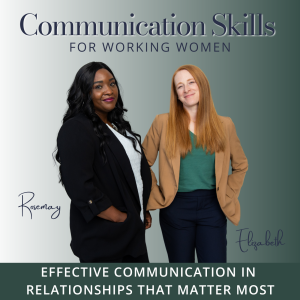
Communication Skills for Working Women Podcast:Effective Communication, Healthy Relationships, Direct Communication
We’re Elizabeth and Rosemay, women, mothers, spouses, friends. Rosemay is a therapist and current PhD candidate, and Elizabeth is a facilitator and coach.
Over the last 20 years, we’ve lived, worked, and studied across different industries and cultures, and one thing has become clear: there’s no substitute for communication. Skill gaps can be fixed, connection is a basic human need, and when you learn to communicate with clarity, you can truly thrive.
We look forward to meeting you!
This podcast is designed to help you do just that. Each week, we share practical, communication skills you can apply right away, at work, at home, and in the relationships that matter most.
🎧 Hit play to learn a new skill you can start using today.
Ready to dive deeper?
✨ Visit us at: communicateconnectthrive.com
✨ Email us: communicationskillsforwomen@gmail.com
✨Facebook: Develop confidence in relationships through effective communication skills
✨ Instagram: Communicationskillsforwomen https://www.instagram.com/communicationskillsforwomen/?hl=en





Episodes
Mar 18, 2026
Mar 18, 2026
8 min
In this midweek drop, we explore how to stay grounded in your sense of agency at work—even when the world outside feels overwhelming. When stress is high, everyday workplace dynamics can start to feel intense, urgent, or even threatening. This episode breaks down how to move through those moments with more clarity, steadiness, and self-trust.
We talk about the difference between power and pressure, why your nervous system may be reacting to more than just what’s happening at work, and how to reclaim small, meaningful moments of choice throughout your day.
Mar 16, 2026
Mar 16, 2026
15 min
Does your chest tighten the moment you need to bring something to your manager's attention?
Do you rehearse conversations with authority figures so many times that you either over-explain or avoid them altogether?
Have you ever said nothing — not because you had nothing to say, but because the risk felt too high?
Anxiety around authority isn't a professionalism problem — it's a nervous system response. This episode helps you communicate upward with clarity instead of panic.
Name your goal — clear, grounded communication, not impressing anyone
See what you're doing — over-explaining, apologizing excessively, delaying difficult conversations
Name your worries — "I'll look incompetent" / "One wrong move could define me"
Identify hidden commitments — staying safe, protecting your image, avoiding mistakes
Test your assumptions — "Managers expect perfection" feels true but it's testable
Four experiments to try:
Lead with the headline
Separate facts from feelings
Ask for direction, not permission
Say your point, stop, and let it land
Key reminder: Authority doesn't require self-erasure. Clarity is not disrespect.
This week, notice one interaction with authority that triggers anxiety. Name the worry, identify the hidden commitment, and choose one experiment. Communicate once without over-performing.
At Communicate Connect Thrive, we believe you can hold both respect and self-trust at the same time — and this episode shows you exactly how. Power doesn't have to produce panic when you have a framework to stand on.
Connect with us!
Instagram: @communicationskillsforwomen
Website: communicateconnectthrive.com
Email: communicationskillsforwomen@gmail.com
Until next time — speak clearly and listen bravely.
Mar 11, 2026
Mar 11, 2026
7 min
In this episode you’ll learn:
• Why feeling evaluated at work can trigger anxiety—even for experienced professionals• The simple attention shift that helps you regain confidence in meetings• How a quick pause and breath can reset your nervous system• Why having a clear communication goal makes meetings easier to lead• How staying flexible can improve collaboration and outcomes
Key takeaway
When you feel evaluated, your attention often turns inward.But strong communication happens when you return your focus to the purpose of the conversation.
Try this in your next meeting
Pause and breathe – regulate your body before responding
Reconnect to your goal – ask: What am I here to accomplish?
Stay flexible – allow new ideas and perspectives to emerge
Remember
You are doing better than you think.
Speak clearly.And listen bravely.
Mar 9, 2026
Mar 9, 2026
25 min
Does hearing "can I give you some feedback?" make your stomach drop before the person even finishes the sentence?
Do you replay feedback on a loop long after the conversation is over?
Have you ever walked away from feedback convinced it meant you were failing — when it may have just meant you were growing?
Spiraling after feedback doesn't mean you're weak — it means your system is treating information like a threat. This episode helps you change that.
Name your goal — stay grounded and curious instead of defensive or collapsed
See what you're doing — overanalyzing tone, assuming the worst, withdrawing afterward
Name your worries — "This confirms I don't belong" / "One mistake could define me"
Identify hidden commitments — being seen as competent, not disappointing others
Test your assumptions — "Good employees don't need this kind of feedback" is testable
Four experiments to try:
Ask for scope — how big a priority is this really?
Clarify the behavior, not the self
Reflect back what you heard
Name growth without defensiveness
Key reminder: Feedback is information, not identity.
This week, notice one moment when feedback triggers anxiety. Pause before interpreting it. Name the worry and the assumption underneath it. Then choose one response experiment and stay curious instead of collapsing.
Communicate Connect Thrive is built on the belief that discomfort is the doorway to insight — and nowhere is that more true than in how we receive feedback. This episode gives you the tools to walk through that door with your confidence intact.
Connect with us!
Instagram: @communicationskillsforwomen
Website: communicateconnectthrive.com
Email: communicationskillsforwomen@gmail.com
Until next time — speak clearly and listen bravely.
Mar 4, 2026
Mar 4, 2026
6 min
In This Episode We Discuss:
What microaggressions between women can look like in the workplace
Why these moments can feel especially painful or confusing
Scarcity culture and the “only one seat at the table” phenomenon
Internalized sexism and alignment with dominant workplace norms
How race, sexuality, age, motherhood, neurodivergence, and class shape power dynamics among women
The difference between intent and impact
Moving from competition to collective advancement
Key Themes
Microaggressions Are Often Subtle but Cumulative Small comments about tone, ambition, appearance, or commitment can reinforce harmful stereotypes and signal who “belongs.”
Diversity Changes the Power Conversation Not all women hold the same social power. Intersections of race, sexuality, disability, age, and motherhood status influence workplace experiences.
Scarcity Fuels Competition When leadership representation is limited, women may unconsciously compete for proximity to power rather than collaborate.
Intent Does Not Erase Impact Even well-meaning comments can reinforce exclusion. Awareness matters.
Solidarity Is a Practice Supporting other women requires intention, not assumption.
Reflection Questions
Have I ever felt smaller after interacting with another woman at work? What specifically shifted?
Where might I unconsciously judge other women for being “too much” or “not enough”?
How has scarcity culture shaped the way I navigate leadership or visibility?
If I hold power in my workplace, how am I using it to amplify others?
Practical Takeaways
Amplify other women’s ideas in meetings.
Interrupt subtle dismissals.
Credit contributions publicly.
Examine internalized narratives about leadership, tone, and competence.
Shift from competition to collaboration.
Why This Matters
Inclusive cultures aren’t built by accident. They’re built when individuals become conscious of how power moves — and choose to move differently.
Diversity isn’t just about representation. It’s about how we distribute voice, validation, and opportunity.
When women move from scarcity to solidarity, workplaces change.
We would love to connect with you.
Facebook: Communication Skills for Working Women
Visit our website: communicateconnectthrive.com
Email: communicationskillsforwomen@gmail.com
Mar 2, 2026
Mar 2, 2026
28 min
Microaggressions between women in the workplace are often subtle, confusing, and deeply invalidating. In this episode, we explore why they hurt more when they come from another woman—and how to respond with clarity, boundaries, and self-trust.
In This Episode, We Cover:
Why harm from within the group is harder to name
How internalized sexism and scarcity show up relationally
Four practical, psychologically grounded responses to microaggressions
Why validation matters more than confrontation
Key Takeaway:You don’t need to prove harm to protect yourself. Trusting your experience is enough.
We would love to connect with you.
Facebook: Communication Skills for Working Women
Visit our website: communicateconnectthrive.com
Email: communicationskillsforwomen@gmail.com
Feb 25, 2026
Feb 25, 2026
7 min
We'd love to connect with you in the Facebook group: Communication Skills for Working Women
You asked for help.You thought you were clear.And it landed… wrong.
The tone shifted.The energy changed.Now you’re wondering if you just made yourself look incompetent.
In this short solo episode of Communication Skills for Working Women, we talk about what to do when your ask doesn’t go the way you expected.
Because sometimes it’s not incompetence.
Sometimes it’s timing.Sometimes it’s stress.Sometimes it’s context you can’t see.
And repair is part of professional communication.
In This Episode You’ll Learn:
Why asking for help can feel high-risk at work
How timing affects how your request is received
What to do instead of panicking when the energy shifts
Why the first attempt is not the final verdict on your competence
How to create space and revisit a conversation strategically
Four ways to ask for help that signal initiative, not insecurity
Four Strategic Experiments to Try at Work
1. Show Your Work Before You Ask“I’ve tried A and B and I’m not getting the result I need. Can you help me understand what I’m missing?”
Signals effort. Protects credibility. Invites collaboration.
2. Frame the Ask Around Impact, Not Your LimitationShift from “I’m confused” to “I want to make sure we get this right.”
Leaders respond to outcomes.
3. Ask to Learn the System, Not Just Fix the Moment“I’d love to understand your process so I can handle this independently going forward.”
Shows ownership and long-term thinking.
4. Name the Gap Without Apologizing for It“I don’t have visibility into X yet. Can you walk me through it?”
Neutral. Clear. Direct.
The Real Takeaway
If your first ask lands wrong, that does not mean you are incompetent.
You are allowed to:
Pause.
Revisit.
Clarify.
Try again.
Asking for help is not a one-shot performance.
It’s an experiment.
And capable professionals don’t grow by struggling silently — they grow by asking strategically.
Feb 23, 2026
Feb 23, 2026
26 min
Do you ever sit with a problem longer than you should because asking for help feels like admitting you don't belong?
Have you ever drafted an email asking for help, then closed it without sending?
Does needing support feel like evidence that you're failing?
The barrier to asking for help isn't pride — it's an internal system convinced that needing support means you're failing. This episode changes that story.
Name your goal — ask in ways that signal resourcefulness, not limitation
See what you're doing — waiting too long, asking peers instead of supervisors, over-apologizing
Name your worries — "They'll think I'm not smart enough" / "Everyone else figured this out already"
Identify hidden commitments — appearing self-sufficient, proving you deserve to be here
Test your assumptions — "Competent people don't need much help" feels true but it's testable
Four experiments to try:
Show your work before you ask
Frame the ask around impact, not your limitation
Ask to learn the system, not just fix the problem
Name what you don't know without apologizing for it
Key reminder: Asking strategic questions is a competence signal — not a weakness signal.
This week, notice one moment you need help but hesitate to ask. Name the worry, identify the assumption, and choose one experiment. Ask once before you talk yourself out of it.
At Communicate Connect Thrive, we know that connection and growth happen when we're willing to be honest about what we need. Asking for help is one of the most powerful ways to do both.
Connect with us!
Instagram: @communicationskillsforwomen
Website: communicateconnectthrive.com
Email: communicationskillsforwomen@gmail.com
Until next time — speak clearly and listen bravely.
Feb 18, 2026
Feb 18, 2026
6 min
In this short mid-drop episode, we continue to explore imposter syndrome—also known as the impostor phenomenon—and why it disproportionately impacts women, particularly those from marginalized communities.
Feb 16, 2026
Feb 16, 2026
16 min
Have you ever had a good idea in a meeting and talked yourself out of saying it before anyone could respond?
Do you ever feel like you're one question away from being "found out"?
Have you ever over-prepared, over-explained, and still felt like it wasn't enough?
Imposter syndrome isn't a confidence problem — it's a protection strategy. In this episode we use our communication framework to understand what's really happening and how to show up anyway.
Name your goal — credible presence, not perfection
See what you're doing — over-preparing, staying quiet, adding disclaimers are all information
Name your worries — "I'll sound inexperienced" / "They'll realize they made a mistake"
Identify hidden commitments — protecting your reputation, avoiding early mistakes
Test your assumptions — "Competent people don't hesitate" feels true but it's not
Four experiments to try:
Speak in drafts: "I'm still thinking this through, but one idea might be…"
Ask strategic questions
Drop the apology before your question
Name your learning without disqualifying yourself
Key reminder: Confidence is built through action — not certainty.
This week, notice one moment imposter syndrome shows up. Identify the worry, the hidden commitment, and the assumption underneath it. Then choose one small experiment and speak once before you talk yourself out of it.
Communicate Connect Thrive exists to help you move from discomfort to insight to confident visibility — and this episode is that formula in action.
Connect with us!
Instagram: @communicationskillsforwomen
Website: communicateconnectthrive.com
Email: communicationskillsforwomen@gmail.com
Until next time — speak clearly and listen bravely.