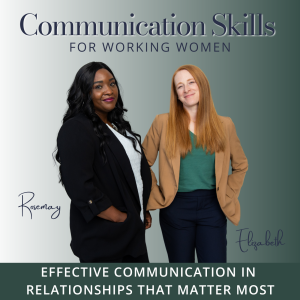
Communication Skills for Working Women Podcast:Effective Communication, Healthy Relationships, Direct Communication
We’re Elizabeth and Rosemay, women, mothers, spouses, friends. Rosemay is a therapist and current PhD candidate, and Elizabeth is a facilitator and coach.
Over the last 20 years, we’ve lived, worked, and studied across different industries and cultures, and one thing has become clear: there’s no substitute for communication. Skill gaps can be fixed, connection is a basic human need, and when you learn to communicate with clarity, you can truly thrive.
We look forward to meeting you!
This podcast is designed to help you do just that. Each week, we share practical, communication skills you can apply right away, at work, at home, and in the relationships that matter most.
🎧 Hit play to learn a new skill you can start using today.
Ready to dive deeper?
✨ Visit us at: communicateconnectthrive.com
✨ Email us: communicationskillsforwomen@gmail.com
✨Facebook: Develop confidence in relationships through effective communication skills
✨ Instagram: Communicationskillsforwomen https://www.instagram.com/communicationskillsforwomen/?hl=en





Episodes
2 days ago
2 days ago
17 min
Struggling to Speak Up at Work? 5 Ways to Communicate with Confidence Without Undermining Your Ideas
Connect with us at:
communicationskillsforwomen@gmail.com
Rosemay Webster on LinkedIn
Elizabeth Amorino on LinkedIn
We'd LOVE to hear from you.
Have you ever shared an idea at work and immediately questioned yourself? Maybe you’ve started a sentence with “I don’t know if this makes sense, but…” or ended a thought with “Does that make sense?” before anyone has had a chance to respond.
In this episode of Communication Skills for Working Women, we explore how the words we use can unintentionally undermine our ideas—and how to communicate with greater confidence without losing our authenticity or openness to collaboration.
In this episode, we unpack why women sometimes qualify their ideas, soften their opinions, or apologize before speaking up. We discuss how past experiences, fear of judgment, and workplace power dynamics can influence the way we communicate, especially when speaking with senior leaders or colleagues.
You’ll learn how to:
Recognize qualifying language and notice when it’s undermining your message.
Understand why you may soften your ideas out of fear of being judged, misunderstood, or perceived as arrogant.
Distinguish confidence from certainty and learn why you don’t need all the answers to contribute something valuable.
Replace self-undermining phrases with clear, confident alternatives.
Ask questions, share recommendations, and invite collaboration without unnecessarily apologizing or seeking reassurance.
Practice small communication shifts that help you speak up while still sounding like yourself.
We also walk through practical workplace examples, including sharing ideas in meetings, asking for clarification, and expressing concerns about unrealistic deadlines.
Your takeaway: You don’t have to be 100% certain to communicate clearly. Start by noticing one phrase you use out of habit and practice replacing it with language that reflects what you actually mean.
Ready to strengthen your communication skills?
Take our free Communication Skills Gap Quiz to identify opportunities to grow in the communication skills that matter most in your work and relationships.
Interested in bringing practical communication workshops or group coaching to your women’s employee resource group (ERG), leadership team, or organization? Reach out to start a conversation.
If this episode resonates with you, share it with a friend or colleague and leave us a review to help more women find practical ways to communicate with confidence.
Remember: Speak Clearly and Listen Bravely.
Keywords
Communication skills for women, women in the workplace, confident communication, how to speak up at work, workplace communication, professional development for women, communication confidence, qualifying language, stop undermining your ideas, assertive communication, women in leadership, leadership communication, public speaking confidence, people-pleasing at work, effective communication, workplace relationships, communication skills training, women’s leadership development.
7 days ago
7 days ago
31 min
Connect with us at:
communicationskillsforwomen@gmail.com
Rosemay Webster on LinkedIn
Elizabeth Amorino on LinkedIn
We'd LOVE to hear from you.
Take the free Communication Skills Gap Quiz
Confidence Comes After You Start with Makeda Boehm
What if confidence isn’t something you need before you take the leap—but something you build by taking it?
In this episode of Communicate Connect Thrive, we sit down with Makeda Boehm, Strategic AI and Digital Workforce Architect and founder of Seed & Society, to explore why confidence comes from participation, not perfection.
Makeda’s unconventional career journey took her from earning her GED at 16 and working as a teacher to breaking into enterprise technology sales, closing nearly $10 million in deals, and building her own business using AI-powered systems. Along the way, she learned that confidence doesn’t come from waiting until you feel ready. It comes from showing up, taking action, and gathering evidence of what you’re capable of doing.
If you’ve ever second-guessed yourself, waited for the perfect moment, or wondered whether you’re qualified enough to pursue your next opportunity, this conversation is for you.
In This Episode, We Discuss:
Why so many women wait to feel confident before taking action.
How to move forward when imposter syndrome and self-doubt show up.
What an “evidence library” is and how it helps build lasting confidence.
How to advocate for yourself, pursue promotions, and take up space in rooms where you feel like an outsider.
How taking action can help women embrace entrepreneurship, new technology, and unfamiliar opportunities.
How AI can help service-based business owners reclaim their time and build more sustainable businesses.
Are You Holding Yourself Back?
Maybe you’re waiting to apply for the promotion, raise your rates, speak up in a meeting, launch your business, or try something new because you don’t feel ready yet.
For working women, self-doubt can show up as:
Imposter syndrome: Feeling like you have to prove yourself more than everyone else before you deserve a seat at the table.
Perfectionism: Overpreparing, overthinking, and delaying action until everything feels just right.
Fear of failure: Worrying that one mistake will undermine your credibility or confirm your doubts about yourself.
Difficulty advocating for yourself: Struggling to ask for a raise, negotiate compensation, share your accomplishments, or set higher rates.
The pressure to prove your worth: Feeling that you must work harder, know more, or be more qualified than your peers to be taken seriously.
Career transition anxiety: Wondering whether you can succeed when stepping into a new role, industry, leadership position, or business venture.
Technology overwhelm: Feeling behind or intimidated by AI and other emerging tools.
The confidence gap: Knowing you have something valuable to offer but hesitating to make yourself visible or pursue the next opportunity.
Two Takeaways to Put Into Practice
1. Confidence is a result, not a requirement.
Choose one thing you’ve been waiting to feel ready for and take the smallest possible step toward it this week. You don’t have to eliminate your fear before you begin.
2. Build an evidence library.
Start collecting proof of your capabilities. Save the positive feedback, successful presentations, completed projects, difficult conversations you navigated, goals you achieved, and moments when you did something that once intimidated you. When self-doubt creeps in, revisit that evidence.
You don’t have to rely on how confident you feel in the moment. You can remind yourself of what you’ve already done.
Connect with Makeda Boehm
Learn more about Makeda’s work in AI, digital workforce systems, and helping service-based business owners reclaim their time.
Website: https://seedandsociety.com
LinkedIn: https://www.linkedin.com/in/makedaboehm
Explore her Free AI Employee Report, More Money & Time Labs, and the Seed & Society Podcast.
Your Challenge This Week
What is one thing you’ve been waiting to feel confident enough to do?
Take one small step toward it this week. Send the email. Speak up in the meeting. Submit the application. Share the idea. Start the project.
Stop waiting for confidence to arrive. Start building the evidence that you can do hard things.
If this episode resonates with you, share it with a woman who needs a reminder that she doesn’t have to feel ready to get started. Follow Communicate Connect Thrive for more conversations about communication, connection, and thriving at work and in life.
Speak clearly. Listen bravely.
Oct 19, 2026
Oct 19, 2026
23 min
Connect with us at:
communicationskillsforwomen@gmail.com
Rosemay Webster on LinkedIn
Elizabeth Amorino on LinkedIn
We'd LOVE to hear from you.
What Am I Actually Trying to Say?
Have you ever rehearsed a difficult conversation over and over without getting any closer to knowing what you want to say?
In this episode, we explore why that happens and how getting clear before a conversation can help you communicate with greater confidence and purpose.
You'll learn how to separate what happened from what you're feeling and assuming, identify what you need, and use five questions to prepare for a more productive conversation.
In this episode:
Why we get stuck rehearsing conversations in our heads
The difference between facts, feelings, and assumptions
Five questions to ask before a difficult conversation
How to turn frustration into a clear request
Your challenge: Pick one conversation you've been avoiding and work through the five Get Clear questions.
Take the free Communication Skills Gap Quiz
Bring communication skills to your organization: If your women's ERG, leadership team, or organization wants practical communication workshops or group coaching, contact us to start a conversation.
If this episode helped you, share it with a friend or colleague and leave us a review.
Thanks for listening! Remember, Speak Clearly & Listen Bravely.
One final production suggestion: keep the Get Clear worksheet as the episode's one main tool. The facts-feelings-assumptions distinction supports the worksheet, rather than becoming a second competing framework. That makes the episode easier to remember and gives listeners one concrete action to take immediately.
Oct 14, 2026
Oct 14, 2026
22 min
Episode Title:Stop Reacting. Start Choosing: The Communication Shift That Changes Everything
Connect with us at:
communicationskillsforwomen@gmail.com
Rosemay Webster on LinkedIn
Elizabeth Amorino on LinkedIn
We'd LOVE to hear from you.
What You’ll Learn:
Why reaction mode keeps you stuck in conflict and stress
How future orientation changes the way you communicate
A simple 3-step framework (W.I.N. Method™) to respond with clarity
How to regulate your emotions and protect your energy in difficult moments
Guest:Jackie Miller is a high-conflict divorce coach, speaker, and author who helps women break toxic communication cycles, regulate their nervous system, and communicate from strength instead of survival.
Go-To Phrases:👉 “Is this moving me toward the future I want?”👉 “Pause before you respond.”👉 “Choose your response, don’t default to reaction.”
Connect with Jackie:Website: jackiemillercoaching.comPodcast: Out of CrazytownBook: WINNING: Rewiring Your Brain and Reclaiming Your Life After Toxic Love
Oct 12, 2026
Oct 12, 2026
13 min
Connect with us at:
communicationskillsforwomen@gmail.com
Rosemay Webster on LinkedIn
Elizabeth Amorino on LinkedIn
We'd LOVE to hear from you.
Episode Title:
Work-Life Balance Isn’t Working: What actually works?
What You'll Learn:
Why work-life balance can become another unrealistic expectation
The difference between work-life balance and work-life integration
How to communicate your capacity at work
How to set boundaries without guilt
Why different seasons require different priorities
How communication skills can reduce overwhelm and burnout
Action Step:
Identify:
One thing to protect. One thing to release. One thing to renegotiate.
Oct 7, 2026
Oct 7, 2026
22 min
Content Warning:
This episode discusses domestic violence, abuse, and violence against women. This may be difficult or triggering for some listeners. Please take care of yourself while listening and choose what feels right for you.
Need Support?
If you or someone you know is experiencing domestic violence, support is available through the National Domestic Violence Hotline.
Call: 800-799-7233Text: START to 88788Online: The National Domestic Violence Hotline
If you are in immediate danger, contact emergency services in your area.
Connect with us at:
communicationskillsforwomen@gmail.com
Rosemay Webster on LinkedIn
Elizabeth Amorino on LinkedIn
We'd LOVE to hear from you.
Episode Title:
Listening Beyond the Silence: How Connection Can Help Us Recognize Domestic Violence
What You’ll Learn:
Why domestic violence can be difficult to recognize—even when it is happening to someone we know
How connection and paying attention can help us notice when someone may need support
Why education and awareness are important tools for domestic violence prevention
How we can show up for the women in our lives without judgment or assumptions
Why domestic violence can affect women across every profession, community, and socioeconomic background
Guest:
Georeen Tanner is a New York-based producer with experience across television, podcasts, digital, and streaming content. As a producer of true crime documentaries, she has spent years examining stories of violence and the people impacted by it.
Her work has led her to think deeply about the intersection between storytelling, prevention, awareness, and the ways we can better recognize when someone may need help.
Georeen brings an important message to this conversation: showing up matters.
Go-To Phrases:
👉 “Domestic violence doesn’t have a face.”
👉 “Education is key.”
👉 “We need to pay attention to the women around us.”
👉 “90% of life is showing up. Let’s show up for women.”
Connect with Georeen:
LinkedIn: https://www.linkedin.com/in/georeen-tanner
Oct 5, 2026
Oct 5, 2026
16 min
Connect with us at:
communicationskillsforwomen@gmail.com
Rosemay Webster on LinkedIn
Elizabeth Amorino on LinkedIn
We'd LOVE to hear from you.
Friends With Your Boss? Navigating Workplace Friendships, Power & Boundaries
Can you be friends with your boss and still have a healthy professional relationship?
Workplace friendships can be meaningful. You might genuinely like your boss, talk about your families, laugh together, support each other, or even spend time together outside of work. But when friendship and professional roles overlap, things can get complicated quickly.
What happens when your boss makes a decision you disagree with? Do you respond as a friend—or as an employee?
The truth is, friendship doesn't erase hierarchy, and hierarchy doesn't eliminate connection.
In this episode of Communication Skills for Working Women, Elizabeth Amorino and Dr. Rosemay Webster break down how to navigate workplace friendships, professional boundaries, and power dynamics using three simple ideas:
Connection. Role. Power.
Connection: Value the Relationship Without Making Assumptions
A workplace friendship can be a genuine friendship. You can trust someone, care about them, talk about your family, and enjoy spending time together.
But personal connection doesn't automatically mean you can communicate with each other exactly as you would outside of work.
You might find yourself thinking:
“We're friends, so I should be able to tell them anything.”
“We're close, so they should understand how I feel.”
“If I disagree with them, I'm going to damage our friendship.”
Instead of making assumptions, pause and recognize both parts of the relationship.
“I value this relationship, and I also recognize that we're at work.”
Connection means valuing the relationship without expecting the friendship to erase the professional context.
Role: Know Who You Are to Each Other at Work
The same person can occupy multiple roles in your life.
Your boss might also be your friend. A colleague might be a mentor. Someone you genuinely like might also be responsible for evaluating your performance.
Those professional roles don't disappear because you have a personal connection.
When an important conversation comes up, ask yourself:
“Which role am I communicating from right now?”
If you're discussing a work decision, communicate professionally. If you're giving feedback, recognize the professional role you're in. If you're having a personal conversation, recognize that you're shifting into a different part of the relationship.
One helpful phrase is:
“I value our relationship, and I want to approach this conversation professionally.”
Role gives you clarity about how to communicate at work.
Power: Recognize Who Has Authority
Power is an important part of any workplace relationship.
If someone has authority over your:
Pay
Promotion
Schedule
Performance evaluation
Opportunities
Responsibilities
there is a power difference—even when you genuinely like each other.
That power difference can influence communication. You might hesitate to disagree, feel pressure to say yes, or worry that speaking honestly could affect your relationship or your career.
It can also create the perception of favoritism among other employees.
Ask yourself:
“Is this relationship affecting what I feel comfortable saying or doing?”
Recognizing power doesn't mean the relationship is unhealthy. It means the power difference deserves to be acknowledged.
You can communicate honestly while still protecting the professional relationship.
Try:
“I'm going to push back on this decision because of my perspective on the work—not because of our relationship.”
Connection. Role. Power.
When a workplace relationship feels complicated, come back to these three questions:
Connection: What is our relationship?
Role: What are our professional roles?
Power: Where does authority exist between us?
You don't have to choose between being human and being professional.
You can have connection and boundaries.
You can value a friendship while still recognizing the professional relationship.
And sometimes, clarity is what allows connection to remain healthy.
Your Communication Challenge
Think about one workplace relationship that feels complicated.
Ask yourself:
Connection: What is our relationship?
Role: What are our professional roles?
Power: Where does authority exist between us?
Then ask yourself:
“Is there anything I'm avoiding saying because I'm afraid it will change the relationship?”
You don't have to say it today.
Start by getting clear with yourself.
Because when you understand the connection, role, and power in a workplace relationship, you have a much clearer starting point for your next conversation.
If This Episode Resonates
Follow Communication Skills for Working Women and share this episode with another working woman who might be navigating a complicated workplace friendship, difficult conversation, professional boundary, or power dynamic.
We're here to help you communicate with more clarity and confidence in the relationships that matter most.
Speak Clearly and Listen Bravely.
The Art and Science of Connection
Sep 30, 2026
Sep 30, 2026
9 min
Thursday, October 18:00 PM Mountain / 10:00 PM Eastern
Register here:https://forms.gle/A9TrDUsqZAPKBjCL7
Thriving Through Transitions: You Don’t Have to Have It All Figured Out
Have you ever been in a season of life where you thought, “I should know what I’m doing by now”—but you don’t?
Maybe your career has changed. Your children are growing up. You’re caring for an aging parent. Your relationship looks different. You’ve moved, experienced a loss, or simply realized that the life you’ve been living doesn’t quite fit anymore.
Transitions can bring a mix of emotions—excitement, sadness, relief, fear, hope, overwhelm, and uncertainty. And sometimes, the hardest part is feeling like you’re supposed to have everything figured out.
In this episode of Communication Skills for Working Women, we’re talking about how communication can help you navigate life transitions with more clarity and confidence.
You Don’t Have to Have It All Figured Out
A transition is a process, not a straight line.
Instead of asking yourself, “What should I do?” try asking:
“What do I need right now?”
You might need rest, information, support, time to think, a boundary, a difficult conversation, or simply someone to listen.
Once you recognize what you need, the next communication skill is learning to say it clearly.
You can say:
“I need some time to think about this.”
“I need you to listen right now. I’m not looking for a solution.”
“I’m realizing I need some help.”
“I don’t know exactly what I need yet, but I know something needs to change.”
“I’m still figuring this out.”
You don’t have to understand everything before you communicate. You can communicate uncertainty.
Look at Your Transition as a Whole
We also talk about a simple timeline exercise that can help you see your transition differently.
Think about a significant transition in your life and map what happened afterward. Some experiences may have been difficult, while others brought joy, hope, peace, growth, or unexpected opportunities.
Seeing the whole timeline can remind you that transitions aren't usually a straight line.
You can have a difficult day and then experience something wonderful. You can feel like you’re making progress and then suddenly feel uncertain again.
Instead of asking, “Why am I still struggling with this?” try asking:
“What is this part of the transition showing me?”
and
“What do I need now?”
Your Communication Skill for Today
Take one minute to pause and ask yourself:
What am I feeling?
What do I need?
What is one thing I can communicate clearly?
Your answer might lead to a conversation with your spouse, boss, friend, adult child, parent, or someone else in your life.
You may need to ask for support, set a boundary, say no, clarify what you need, or simply tell someone:
“I’m still figuring this out.”
You don't have to solve the entire transition today.
You just need to communicate the next thing.
Join Our Free Thriving Through Transitions Workshop
If this episode sounds like the season of life you're currently experiencing, Elizabeth and Rosemay invite you to join their free 60-minute Thriving Through Transitions workshop.
This online workshop is designed for working women who are navigating a life transition and want a chance to slow down, reflect, connect, and identify meaningful next steps.
Together, we'll explore where you've been, what you're experiencing now, and where you want to go next—with practical communication skills you can use beyond the workshop.
Join us:
Thursday, October 18:00 PM Mountain / 10:00 PM Eastern
Register here:https://forms.gle/A9TrDUsqZAPKBjCL7
A replay will also be available for those who can't attend live.
Know a woman who is navigating a transition? Share this episode with her and invite her to join you for the workshop.
Remember
A transition doesn't necessarily mean something is wrong.
Sometimes it simply means something is changing.
You don't need to know the entire path. Start with what you know. Ask yourself what you need. And communicate that next thing clearly.
Because thriving doesn't mean everything feels easy or that you have all the answers.
Sometimes thriving means giving yourself permission to be where you are—and then taking the next step.
Speak Clearly and Listen Bravely.
Sep 28, 2026
Sep 28, 2026
15 min
communicationskillsforwomen@gmail.com
Rosemay Webster on LinkedIn
Elizabeth Amorino on LinkedIn
We'd LOVE to hear from you.
What You’ll Learn:
About the power of choosing your mindset and how that can change your perspective, change your paradigm, and transform your life.
How your mind is a powerful tool that can help you achieve your goals.
Guest:
Heather Hall is a three-time cancer survivor first diagnosed at 21, Heather turned three diagnoses into a philosophy that changes lives. With 20+ years in public relations, communications, and advocacy, she is a nationally recognized keynote speaker, blogger, and communications consultant who teaches people that choice is their most underused resource. Her “Today I Choose” framework helps audiences shift their mindset, reclaim their power, and become their own best advocate in their health, their work, and their life.
Go-To Phrases:
👉 What will you choose today? Today I Choose...
Connect with Heather:
Website: https://www.theheatherhall.comLinkedIn: https://www.linkedin.com/in/heatherhallwriterspeaker
Sep 23, 2026
Sep 23, 2026
13 min
Connect with us at:
communicationskillsforwomen@gmail.com
Rosemay Webster on LinkedIn
Elizabeth Amorino on LinkedIn
We'd LOVE to hear from you.
🎁 FREE WORKSHOP: Thriving Through Transitions
Are you entering a new chapter of life and wondering how to navigate the changes while still showing up for everyone around you?
Join Elizabeth and Rosemay for Thriving Through Transitions, a FREE 60-minute workshop created for women navigating change and uncertainty.
We'll go deeper into practical tools to help you:
Choose the Time That Works for You:
Monday, September 286:00 PM Mountain | 8:00 PM Eastern
Thursday, October 18:00 PM Mountain | 10:00 PM Eastern
Can't attend live? Register for the replay!
👉 REGISTER HERE:https://forms.gle/t599cMHxkk5SFtvK9
Please share this workshop with a woman who may be navigating a major life transition right now.
Connect with us at:
communicationskillsforwomen@gmail.com
Rosemay Webster on LinkedIn
Elizabeth Amorino on LinkedIn
We'd LOVE to hear from you.
In the Middle of Change, Start Here: Name What You Need
Life transitions can leave you feeling overwhelmed, uncertain, and disconnected from what you actually need.
Maybe you're starting a new job, becoming a mom, watching your children grow up and leave home, caring for an aging parent, navigating a relationship change, experiencing grief, or simply realizing that the life you're living doesn't quite fit anymore.
And while you're trying to figure out what's next, you may also be struggling with communication.
You might find yourself thinking:
“I don't know what I need.”
“I don't know how to ask for help.”
“I keep saying yes when I really want to say no.”
“I avoid difficult conversations.”
“Why doesn't anyone understand what I need?”
In this midweek drop, Elizabeth and Rosemay talk about one simple communication skill that can help you navigate transitions with more clarity: naming what you need.
One Simple Skill: Name What You Need
When you're in the middle of change, it's easy to focus on what everyone else needs from you. But before you can communicate clearly with someone else, you often need to pause long enough to understand what's happening inside of you.
Elizabeth and Rosemay walk you through three simple steps:
1. Pause.
Take a breath before you respond, agree to something, or try to solve the entire problem.
2. Ask yourself: “What do I need right now?”
Maybe you need time, help, information, rest, clarity, space, someone to listen, or a boundary.
And remember: A need isn't a demand. Identifying what you need doesn't mean someone else is required to give it to you. It simply gives you valuable information about yourself.
3. Put it into words.
Try:
“What I need right now is ______.”
For example:
“What I need right now is a little more time before I make this decision.”
“What I need right now is for you to listen rather than try to fix this.”
“What I need right now is some help.”
“What I need right now is for us to talk about this when we're both calmer.”
“What I need right now is some space.”
Clear communication doesn't require you to have your entire life figured out.
Sometimes it starts with simply knowing what you need right now.
Your Challenge
Think about one transition you're currently experiencing.
Then ask yourself:
What am I feeling?
And:
What do I need?
Don't worry about solving everything yet. Just name the need.
And if you're ready, take the next step and communicate it to someone:
“What I need right now is…”
It may feel vulnerable or uncomfortable, but clarity starts with understanding yourself—and communication starts when you give someone else the opportunity to understand you.
Join Our FREE Thriving Through Transitions Workshop
If you're navigating a life transition and want practical tools for communicating through change, Elizabeth and Rosemay invite you to join the FREE 60-minute Thriving Through Transitions workshop.
Together, we'll explore practical communication skills to help you navigate the emotions, conversations, relationships, boundaries, and decisions that come with change.
Choose the session that works for you:
Monday, September 28 — 6:00 PM Mountain / 8:00 PM Eastern
Thursday, October 1 — 8:00 PM Mountain / 10:00 PM Eastern
Can't attend live? Register anyway and receive the replay.
Register for Thriving Through Transitions
Because transitions aren't just about what's changing around you.
They're also about how you communicate while you're changing.
In This Episode
Communication during life transitions
How to identify what you need
Why women often struggle to express their needs
Setting boundaries during times of change
Asking for help without guilt
Communicating clearly when you're overwhelmed
How to pause before responding
The difference between having a need and making a demand
A simple script for expressing what you need
Practical communication skills for working women
Navigating career, family, relationship, and personal transitions
How clarity can create more connection during change
Speak Clearly and Listen Bravely.