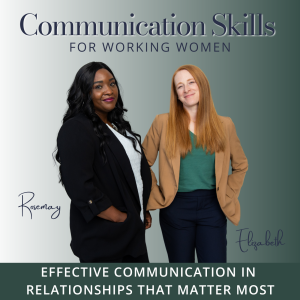
Communication Skills for Working Women Podcast:Effective Communication, Healthy Relationships, Direct Communication
We’re Elizabeth and Rosemay, women, mothers, spouses, friends. Rosemay is a therapist and current PhD candidate, and Elizabeth is a facilitator and coach.
Over the last 20 years, we’ve lived, worked, and studied across different industries and cultures, and one thing has become clear: there’s no substitute for communication. Skill gaps can be fixed, connection is a basic human need, and when you learn to communicate with clarity, you can truly thrive.
We look forward to meeting you!
This podcast is designed to help you do just that. Each week, we share practical, communication skills you can apply right away, at work, at home, and in the relationships that matter most.
🎧 Hit play to learn a new skill you can start using today.
Ready to dive deeper?
✨ Visit us at: communicateconnectthrive.com
✨ Email us: communicationskillsforwomen@gmail.com
✨Facebook: Develop confidence in relationships through effective communication skills
✨ Instagram: Communicationskillsforwomen https://www.instagram.com/communicationskillsforwomen/?hl=en





Episodes
May 4, 2026
May 4, 2026
8 min
We would love to connect with you! Find us at Communication Skills for Working Women
What if that moment at work isn’t small…
What if it’s actually unclear communication?
You’re sitting at your desk, focused, trying to manage your time and get through your to-do list.
And then you hear it—
A question, just… floating in the room.
“Does anyone know where that file is?”“Are we still meeting at 2?”
No name.No direction.No eye contact.
And suddenly—you pause.
Are they talking to me?Am I supposed to answer that?Should I ignore it?
And just like that, your focus is broken.
This is what unclear communication at work does.
It interrupts your time.It increases anxiety at work.And it quietly weakens connection in the workplace.
Because when communication is vague, indirect, or not directed to a person—everyone is left guessing.
And guessing is exhausting.
In this episode, Elizabeth shares a real-life example of how common this is in workplace communication, especially in collaborative or open office environments.
Because while it may seem harmless, this kind of indirect communication creates distraction, confusion, and unnecessary mental load—especially for busy, middle-aged working women who are already balancing responsibilities at work and at home.
The truth is—most of us were never taught clear, effective communication skills for working women.
We were taught to be easygoing.To not interrupt.To keep things casual.
But that often leads to unclear professional communication, where no one knows who is responsible, and everyone is managing low-level stress trying to figure it out.
If you’ve ever felt distracted, overwhelmed, or slightly on edge in a work environment where communication feels indirect or unclear—this episode will give you simple, practical tools to shift that immediately.
You’ll learn how to move from vague, indirect communication to clear communication, so you can reduce anxiety, save time, and build stronger connection at work.
Because strong communication skills don’t just make you more effective—they help you feel calmer, more confident, and more connected in your daily life.
💡 In This Episode, You’ll Learn:
Why unclear communication in the workplace increases anxiety and disrupts focus
How indirect communication wastes time and creates confusion
A simple shift to make your communication clear, direct, and effective
How to build connection at work through intentional communication
How to strengthen professional communication skills without adding more to your plate
✨ A Simple Shift to Try Today
Clear is kind.Unclear is unkind.
Direct is kind.Indirect is unkind.
Say the name.Ask the question clearly.Create clarity instead of confusion.
Because small shifts in communication create big shifts in how you experience your workday.
🎧 Share This Episode
If this episode helped you rethink workplace communication and gave you a simple way to reduce anxiety at work, share it with a friend or colleague who wants clearer communication and stronger connection in their day.
Apr 27, 2026
Apr 27, 2026
15 min
Show Notes
In this episode, we cover:
Adult identity development and workplace expectations
Multicultural tensions in professional environments
How to integrate—not split—your identity
Practical ways to show up authentically
Homework: Notice one moment this week where you adjust yourself—pause and ask why.
Apr 20, 2026
Apr 20, 2026
26 min
Have you ever considered?
Where do I tend to over-adjust in workplace interactions?
When I communicate with certain people, do I feel like myself—or slightly off?
What is my actual goal in these interactions: clarity or approval?
Am I softening, over-explaining, or tiptoeing to manage someone else’s reaction?
What am I worried would happen if I were more direct?
What assumptions am I making about their power vs. mine?
What would it sound like to communicate with both clarity and self-respect?
In this episode, we’re unpacking how to communicate effectively when you’re navigating workplace gatekeepers—those individuals who hold influence without formal authority. If you’ve ever felt the need to manage someone’s mood, soften your message, or walk away from an interaction feeling slightly off, this conversation will resonate.
We introduce a practical framework for staying grounded in unequal power dynamics—so you can communicate with clarity and self-respect without becoming overly accommodating or reactive. This episode is for professionals who want to feel more steady, aligned, and authentic in their communication—even in tricky or high-pressure interactions.
Follow us on Facebook: Communication Skills for Working Women
Share this episode with a colleague or friend navigating office dynamics
Leave a review to help more women build confident, grounded communication
If this episode resonated, your next step is simple:
Pay attention to one interaction this week where you feel the urge to over-adjust.
Instead of changing your message, practice delivering it with:
More clarity
More steadiness
Less over-explaining
This is how you build self-trust in real time.
Remember:You don’t need to overpower the dynamic.You just need to stay anchored in yourself.
Speak Clearly & Listen Bravely
Apr 13, 2026
Apr 13, 2026
22 min
Have you ever walked away from a conversation thinking "that wasn't really me" — but you're not sure exactly what went wrong?
Do you ever find yourself adjusting your tone, your words, or your whole communication style just to match the energy in the room — even when it doesn't feel right?
Have you ever wanted to show up more genuinely but felt like the environment around you made that impossible?
If any of that resonates, this episode is going to hit home.
This episode is not about managing other people or changing the environment around you. It is about something quieter and honestly more powerful — learning to stay aligned with yourself no matter what is happening around you.
Key reminder: Value-consistent communication is an internal practice before it's an external skill.
This week, notice one conversation where you find yourself adjusting to the room instead of showing up as yourself. Before you speak, ask — what would it look like to say this in a way that actually feels like me? You don't have to change the environment. You don't have to say anything dramatic. Just make one small move toward alignment and notice how it feels.
At Communicate Connect Thrive, we believe that confident communication starts on the inside — and this episode is the clearest example of that. When your words match your values, something settles. You walk away from conversations feeling whole instead of slightly off. That is what we are building toward together.
If this episode spoke to you, share it with someone who is working on showing up more authentically — and leave us a review so more women can find this community.
Connect with us!
Instagram: @communicationskillsforwomen
Website: communicateconnectthrive.com
Email: communicationskillsforwomen@gmail.com
Until next time — speak clearly and listen bravely.
Apr 8, 2026
Apr 8, 2026
3 min
Feelings Aren't Facts
Quick story about life and how curiosity helps us navigate our feelings.
Apr 6, 2026
Apr 6, 2026
20 min
Have you ever read a text or email and immediately felt defensive — only to reread it later and realize it was completely neutral?
Have you ever let a feeling — frustration, self-doubt, fear — make a decision for you before you had all the facts?
Have you ever stayed quiet in a meeting, assumed someone was upset with you, or talked yourself out of speaking up — based entirely on how you felt in that moment?
If any of that sounds familiar, this episode was made for you.
One of the biggest things holding us back in our communication isn't our skills or our environment — it's the stories our feelings tell us before we have all the information. In this episode, we break down a real situation that illustrates exactly what it looks like when emotions hijack our communication — and what it looks like when we catch it in time.
This week, notice one moment when a feeling starts writing a story for you before you have all the facts. Before you respond — pause. Reread. Ask yourself what your actual goal is. Then respond from that place instead.
At Communicate Connect Thrive, we believe that the path from discomfort to confident communication runs straight through self-awareness — and this episode is exactly that. When you learn to separate how you feel from what is actually true, your communication becomes clearer, your relationships become stronger, and you stop creating problems that were never really there.
If this episode resonated with you, share it with someone who needs to hear it — and leave us a review so more women can find this community.
Connect with us!
Instagram: @communicationskillsforwomen
Website: communicateconnectthrive.com
Email: communicationskillsforwomen@gmail.com
Apr 2, 2026
Apr 2, 2026
6 min
Speaking up in high-stakes situations can be exhilarating—and exhausting. In this follow-up mini episode, we explore what happens after you share your voice, especially when you’re in a room where your identity or perspective feels hyper-visible.
You’ll learn how to:
Recognize and name the emotional activation that happens after speaking up
Normalize the “emotional hangover” that often follows risk-taking
Reality-check the negative stories your mind may create
Anchor your confidence in your values, not others’ reactions
Create a simple ritual to close the experience and support your nervous system
If you’ve ever replayed a conversation in your head, felt post-speaking anxiety, or worried about how your words landed, this episode gives practical tools to stay grounded, resilient, and on your own side.
Tip: Speaking up is a skill, and managing the aftermath is just as important as the act itself. Use these strategies to turn post-speech anxiety into self-support.
Mar 30, 2026
Mar 30, 2026
20 min
Have you ever walked into a room and immediately felt the weight of being the only one — the only woman, the only person of color, the youngest, the newest?
Do you ever monitor yourself so carefully that by the time you decide it's safe to speak, the moment has passed?
Have you ever felt like your mistakes carry more weight than everyone else's?
Feeling like the only one doesn't mean you're weak — it means you're navigating systems that weren't built with you in mind. This episode gives you practical tools to speak anyway.
This week, notice one moment you feel different and stay quiet because of it. Name the worry, identify the commitment, and choose one small experiment. Speak once — just once — before you talk yourself out of it.
Communicate Connect Thrive was built for moments exactly like this one. When you feel unseen, out of place, or like you're carrying more than your share — we want to help you find your footing and your voice. That is what this work is all about.
Connect with us!
Instagram: @communicationskillsforwomen
Website: communicateconnectthrive.com
Email: communicationskillsforwomen@gmail.com
Until next time — speak clearly and listen bravely.
Caste By Isabel Wilkerson
Mar 25, 2026
Mar 25, 2026
4 min
Communication Skills for Working Women - Facebook Group
One Page Miracle
Vivid Vision
Value the individual even when you don't value their values. People matter, they are important and so are you. Take a deep breath and choose to be the person you want to be, the one that makes you proud, the one 'that fits'.
Interested in Coaching? Message us on our Facebook page linked above!
Mar 23, 2026
Mar 23, 2026
22 min
Have you ever heard someone you love say something harmful and completely frozen — not knowing whether to speak up or let it go?
Have you ever stayed silent in a moment like that and replayed it for days?
Do you ever feel like speaking your truth in certain relationships could cost you the relationship — or your safety?
In this episode we walk through a six-step framework for navigating value misalignment with people you love — without abandoning who you are.
Get clear on your goal — before you speak, know why you're speaking
Look at what you're already doing — silence, subject-changing, and going along are strategies, not failures
Name your worries — "If I speak up I'll lose them" / "If I stay quiet I'm complicit"
Identify hidden commitments — what are you actually protecting underneath the worry?
Design a small experiment — test your assumptions before assuming the worst
Collect data, not self-blame — let evidence guide your next move, not guilt
Key reminder: You are not required to risk your safety to preserve someone else's comfort.
This week, pick one relationship where values feel misaligned. Work through the six steps on paper or before your next conversation. You don't have to fix anything. You just have to respond in a way that keeps you whole.
At Communicate Connect Thrive, we believe clarity and dignity are the foundation of every meaningful conversation — and this framework puts both in your hands.
If this resonated, share it with someone who needs it.
Connect with us!
Instagram: @communicationskillsforwomen
Website: communicateconnectthrive.com
Email: communicationskillsforwomen@gmail.com
Until next time — speak clearly and listen bravely.
Brene Brown - Diary of a CEO Podcast